
Morning view of La Fe Reservoir from an apartment in SG1 (including bird song) El Retiro – Antioquia
Bitcoin emerged during a period of deepening systemic fragility — a response not only to monetary instability, but to the broader erosion of sovereignty experienced by individuals across increasingly centralized societies.
Its revolutionary potential was never confined to digital scarcity alone.
Scarcity without sovereignty merely reproduces hierarchy under a different technological form.
The true significance of Bitcoin lies in its capacity to restore direct ownership, responsibility, and voluntary exchange beyond dependence on centralized monetary authorities. It represents the possibility of rebuilding economic relationships rooted in autonomy rather than permission.
Yet today, a paradox quietly unfolds.
As Bitcoin enters institutional portfolios through ETFs, custodial products, and regulated financial vehicles, it risks integration into the very structures it was intended to transcend. The protocol itself remains decentralized, yet access to it has not ceased to migrate toward centralized gateways:
- custodians,
- regulated exchanges,
- institutional products,
- and state-supervised financial infrastructure.
In this configuration, individuals no longer fully participate in a sovereign monetary network. Instead, they hold mediated exposure through institutional layers that preserve many characteristics of the legacy system.
This distinction matters because monetary transformation does not occur solely through asset appreciation.
Civilizational change emerges when monetary behavior changes.
Bitcoin’s deeper promise was the cultivation of low time preference:
- long-term thinking,
- patience,
- stewardship,
- productive capital allocation,
- local resilience,
- and voluntary cooperation between sovereign individuals.
But low time preference cannot flourish in environments structurally hostile to sovereignty itself.
When trapped within:
- excessive bureaucratic dependence,
- declining property rights,
- punitive taxation,
- fragile social trust,
- regulatory overreach,
- and cultural atomization
an individual will struggle to translate sound money into meaningful autonomy, regardless of Bitcoin’s price performance.
This is where the question becomes geopolitical and civilizational rather than purely financial.
The future of sovereignty depends not only on the monetary tool itself, but on the environments in which sovereign behavior can realistically emerge and sustain itself across generations.
Throughout history, frontier regions and transitional societies have often offered greater space for experimentation, resilience, and parallel structures than mature centralized systems. Such environments tend to reward adaptability, patience, entrepreneurship, and direct participation in local economic life.
In this context, Colombia occupies a uniquely interesting position.
Despite its contradictions and ongoing structural challenges, Colombia still retains characteristics increasingly absent across much of the hyper-financialized Western world:
- lower barriers to tangible asset acquisition,
- stronger human-scale social dynamics,
- fertile agricultural capacity,
- regional decentralization,
- entrepreneurial flexibility,
- and the possibility of building parallel economic relationships outside rigid institutional frameworks.
For sovereignty-oriented individuals, Colombia represents not an escape from reality, but an opportunity to participate more directly in shaping it.
The relevance of Bitcoin within such an environment extends beyond speculation.
Bitcoin becomes meaningful when integrated into:
- productive land,
- resilient communities,
- circular local economies,
- energy independence,
- peer-to-peer exchange,
- and intergenerational stewardship.
Without this grounding, Bitcoin risks becoming merely digital gold enclosed within the architecture of fiat finance — financially successful, yet civilizationally incomplete.
Kompass Frei therefore does not view sovereignty as an abstract ideological posture.
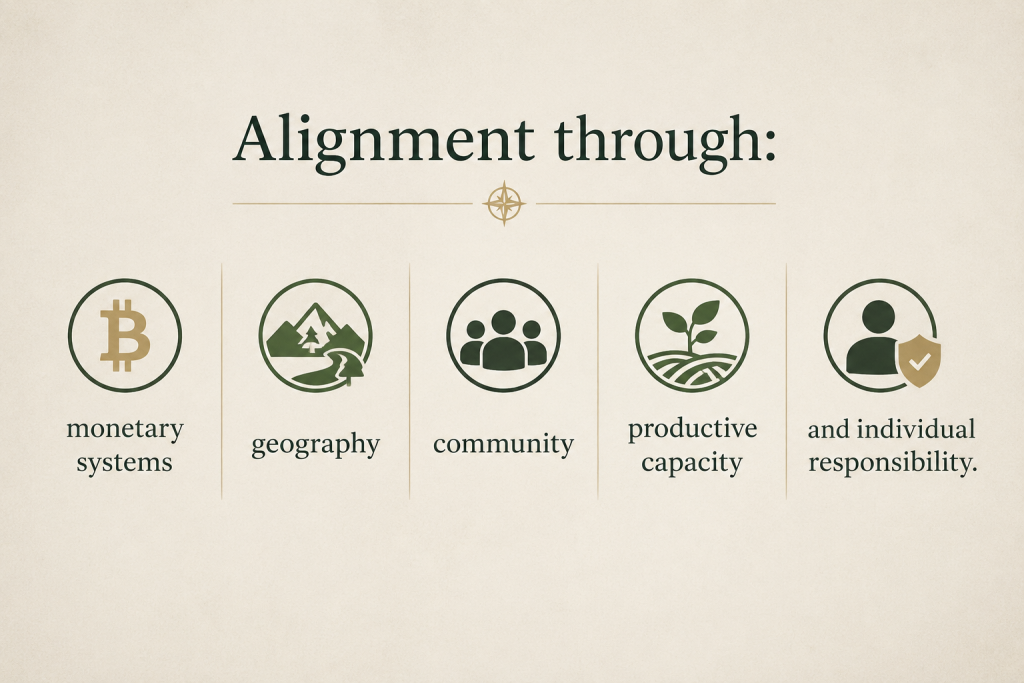
It is a practical process of aligning:
- monetary systems,
- geography,
- community,
- productive capacity,
- and individual responsibility.
The objective is not isolation from the world, but the creation of environments where low time preference behavior is once again rational, rewarded, and sustainable.
The unresolved question is no longer whether Bitcoin survives as an asset class.
The deeper question is whether sovereign individuals will cultivate the environments necessary for its original promise to fully materialize.
Connect through sovereign networks
Follow Kompass Frei on Nostr:
npub1zexwnprn77qc8juaw5cv34xh8s90pwg49pzwcctvhgvrwaqlhgrszzrg9a

Leave a Reply